Competent, Qualified and Certified: What is Required of Crane Operators?
Summary: OSHA regulations and ASME standards require crane operators to be competent, qualified and certified. Competent operators must understand potential lifting hazards and have authority to stop work to avoid them. Qualified operators must be able to do the actual work required for a given lift. Certified operators have independent verification and documentation that they completed a federally recognized certification program. All three elements are required for compliance.
 When you’re dealing with massive machines that cost hundreds of thousands of dollars – and can cost much more if not used properly – it’s important to have the right person for the job.
Crane operators are crucial to construction projects that involve heavy lifting. And because of the significant safety and financial risks associated with lift operations, there are specific and highly regulated requirements that these individuals must meet to legally operate a crane.
Here, we’ll cover these requirements and how contractors can ensure their workforce is safe and compliant.
Who Sets Crane Operator Regulations?
ASME and OSHA are the standard-setting bodies that impact the heavy lift industry.
- The American Society of Mechanical Engineers (ASME) establishes best practices, codes and standards for proper work in industrial and manufacturing settings. While ASME provides the industry recommendations, they are not a legal enforcement group. ASME B30.5 guides the standards related to mobile and locomotive cranes and their operators.
- The Occupational Safety and Health Administration (OSHA) is a federal regulatory agency that sets and enforces legal requirements. OSHA often references industry-leading organizations like ASME when establishing relevant laws. OSHA 29 CFR 1926 Subpart CC governs cranes and derricks in construction, including operator requirements.
What Do ASME and OSHA Require for Crane Operators?
Under both ASME and OSHA, crane operators are required to be three things:
- Competent
- Qualified
- Certified
All three components are required. And all three components must apply to the specific lifting task that is taking place.
These words are often used casually in a general sense. However, these terms have specific definitions under OSHA that must be met for compliance.
What is a Competent Crane Operator?
According to OSHA 1926.1401, a competent person is someone capable of identifying existing and predictable hazards in the surroundings or working conditions, AND has authorization to take prompt corrective measures to eliminate them.
For crane operators, competency means knowing dangerous situations involving cranes, loads and the surrounding area. They must also have the on-site authority to stop work and prevent an incident.
What is a Qualified Crane Operator?
According to OSHA 1926.1401, a qualified person is someone who has successfully demonstrated the ability to solve or resolve problems relating to the subject matter, the work, or the project.
For crane operators, qualification means being familiar with a machine, its specifications and controls. It also requires actually being able to use that specific crane to safely fly a load. These abilities are earned through a combination of training and experience and are demonstrated by putting them into practice.
It’s important to note that operators must be qualified on each specific machine they are going to operate. Even on cranes of the same classification and capacity, different brands or models will have distinctions that can impact the operation of the equipment. To be in compliance with ASME and OSHA, an operator must have familiarity and capability to use the exact crane in the exact scenario for the given lift.
What is a Certified Crane Operator?
A certified person is someone who has been independently assessed and formally recognized by a reputable certification body as having the knowledge and skills required to perform a task.
For crane operators, being certified means having completed the requirements of a federally recognized operator certification program for a given crane type. These programs may include a written assessment, a practical examination, or other elements.
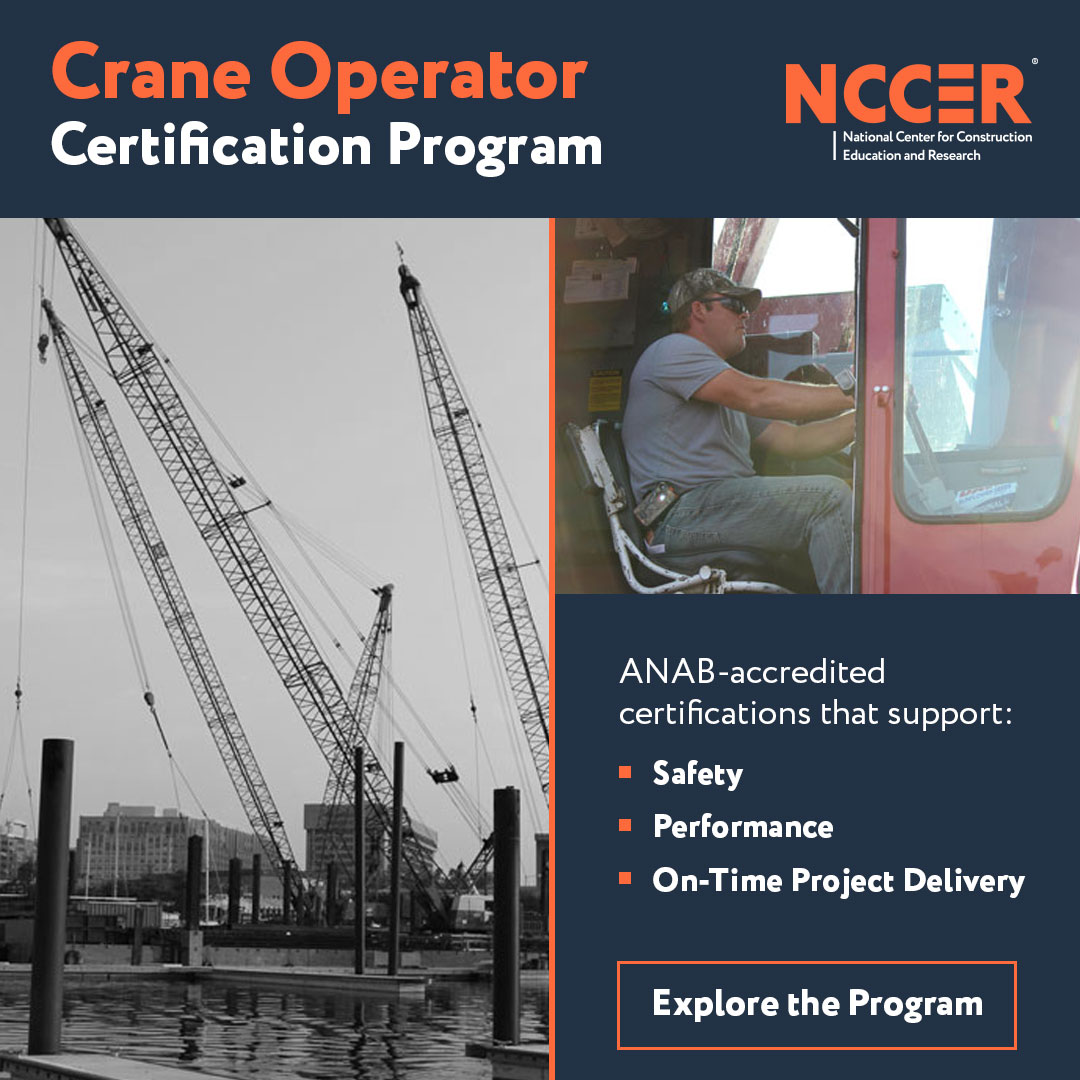 Crane certifications are typically broken down by crane classification. Examples include:
- Articulating Boom Certification
- Boom Truck Certification
- Industrial/Carry Deck Certification
- Lattice Boom Certification
- Service Truck Certification
- Telescopic Boom Certification
A high-quality and rigorous certification program will be designed to measure individuals against industry standards. Crane certifications from trusted institutions like NCCER – who align their assessments with ASME and OSHA and have accreditation with the ANSI National Accreditation Board (ANAB) – can help verify that someone meets the threshold for these standards. Earning a certification shows that someone has a strong foundation for safe and effective crane operation within their certified area.
Crane operator certifications are valid for five years. Operators must renew their certifications to remain compliant and continue operating.
Is a Certified Crane Operator Considered Competent and Qualified?
Not necessarily. From a legal standpoint, a certification only verifies that a person has met the requirements of their certification program. A certification does not confirm someone fully meets the criteria for being competent and qualified to operate in a particular environment.
Certifications give indicators of general capability. However, competency also requires jobsite hazard-prevention authority. This can only be recognized by higher-level project leadership. Certifications also cannot cover all unique variables that may factor into qualification for a specific lift. These include the individual machine, weather, load, potential obstacles and other jobsite conditions.
Certifications are a crucial component of compliance and provide objective documentation. But they are only part of the picture. It is always the responsibility of contractors and employers to take the additional steps needed to ensure operators are competent and qualified, as well as certified, for a given lift situation.
Learn More About Crane Operator Safety and Compliance
Learn more about lift operations safety, ASME/OSHA compliance and how to ensure your crane operators are competent, qualified and certified. Watch our free webinar, featuring heavy lift education experts Ray Rice of NCCER and David Applegate of Rig Tex Training and Consulting.